LKY to produce antimony end products from US project
Our US critical minerals Investment Locksley Resources (ASX: LKY) is about to produce “defence-grade >99% purity antimony”...
With material sourced directly from its project in California, USA.
LKY put out an update this morning from its partnership with Rice University - using Deep Eutectic Solvent (DES) technology to produce antimony end products, including:
- “Defence grade antimony” - used in Bullets and armor-piercing rounds, primers and detonators, flame retardancy, nuclear weapons, night vision and infrared, military batteries and defense electronics. (source)(source)
- Downstream antimony-based materials for batteries and industrial applications - things like antimony-coated nickel substrates (used in high performance batteries and robotics)
All of this is part of LKY’s back to front development strategy - basically developing the processing tech, showing end products that can be produced from LKY’s project, then drilling out the project to prove size/scale potential.
LKY has already produced:
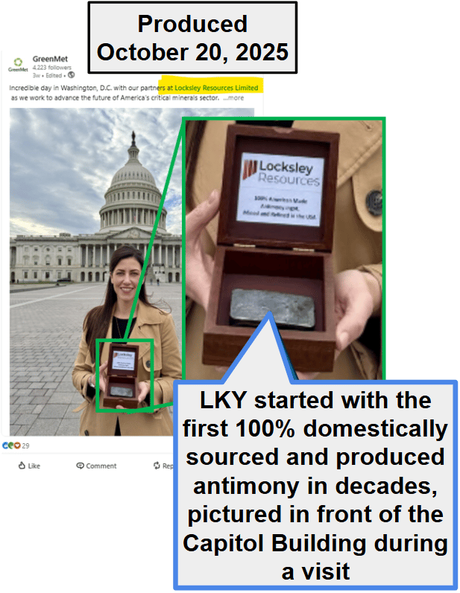
- The first 100% US-sourced and refined antimony ingot in decades (October 2025)
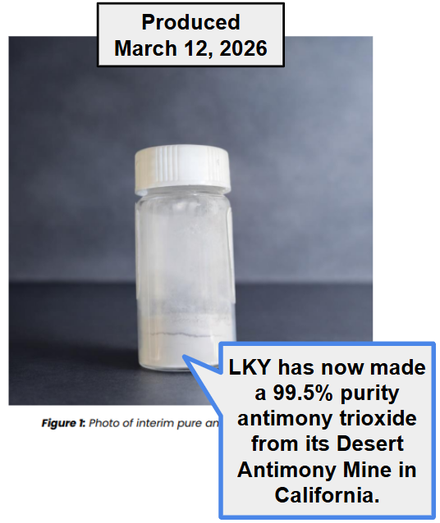
- And a 99.5% purity antimony trioxide - meeting the key threshold for defence qualification (March 2026)
(source)
(source)
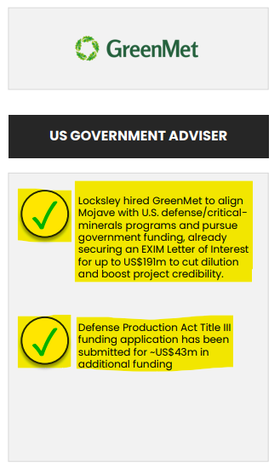
For its project, LKY has also received a US$191 funding Letter of Interest from EXIM and has an application in for more grant funding for US$43M through the US Defense Production Act Title III.
(source)
And is now drilling too (to try to prove up the exploration target of 772K-1.38M tonnes at 2.5-4.9% antimony for ~19,400 tonnes to 67,700 tonnes of antimony metal) . (source)
(see our take on the exploration target relative to other antimony peers here: More on LKY’s historic antimony mine - can it be re-started?)
LKY’s even got an concept renders and has started design and engineering works process with an expression of interest sent out to potential firms for a small-scale plant would look like when it's up and running
See the video below that was released 2 months ago for what it may look like:
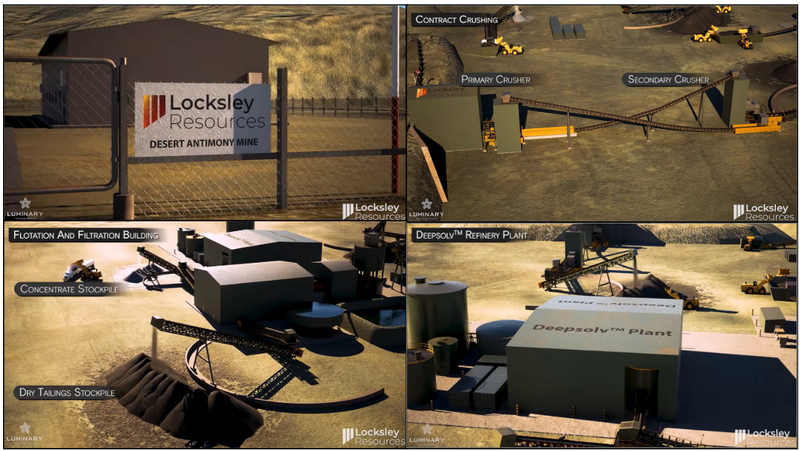
Watch: LKY Desert Antimony Mine Restart Plan
Most mining companies do it the other way around - drill first then worry about everything else, but we think LKY has gone about it the right way considering the urgency around critical minerals in the US.
We think the back to front strategy puts LKY in the best position to get funding support and then backfill whatever terms the funding comes with.
(fingers crossed those funding applications come in)
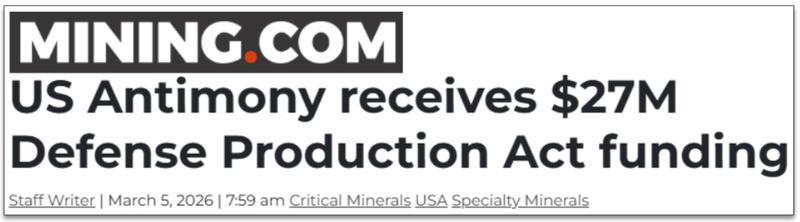
We note that US Antimony Corp received a US$27M investment under the same Defence Production Act Title III program that LKY has applied to just a few weeks ago:
(source)
(no guarantees of course, funding applications are extremely unpredictable and could never eventuate)
More on today’s announcement:
The key technical update from today’s announcement is that LKY and Rice University have shown LKY’s material can be processed without conventional flotation pre-treatment.
Meaning a simpler flowsheet and less processing complexity (which usually means cheaper processing costs).
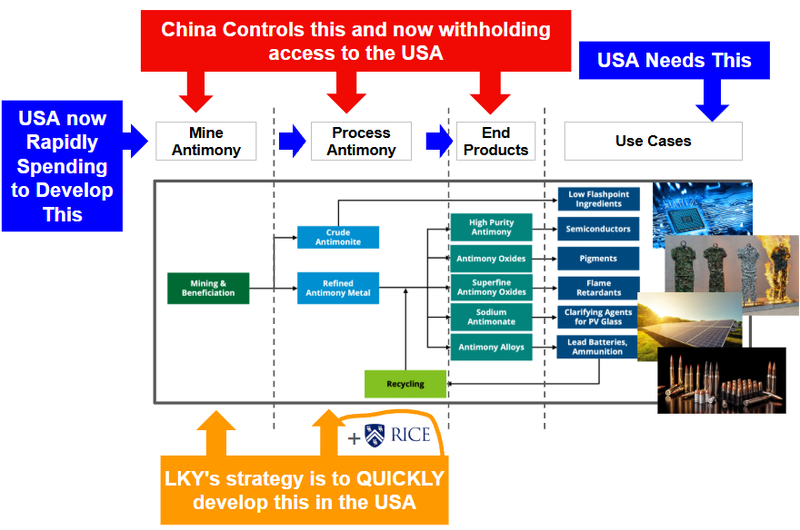
The reason we think the processing updates are important for LKY is because in the US one of the biggest barriers to a US domestic antimony industry isn't necessarily finding the ore.
It’s actually the lack of US processing and refining capability.
China controls over 80% of global antimony processing. (source)
IF LKY can get this DES tech to commercial scale, it would solve that problem with a green, US-based processing solution - applicable not just to LKY's project but potentially to other antimony projects across the country.
We have mentioned this in one of our previous LKY notes - where we listened to an All-in podcast episode a few months ago where the whole topic of why the US stopped processing things like rare earths was discussed.
The main discussion point was about the potential environmental shortfalls and how it was just too hard for the US to even try to solve those problems.
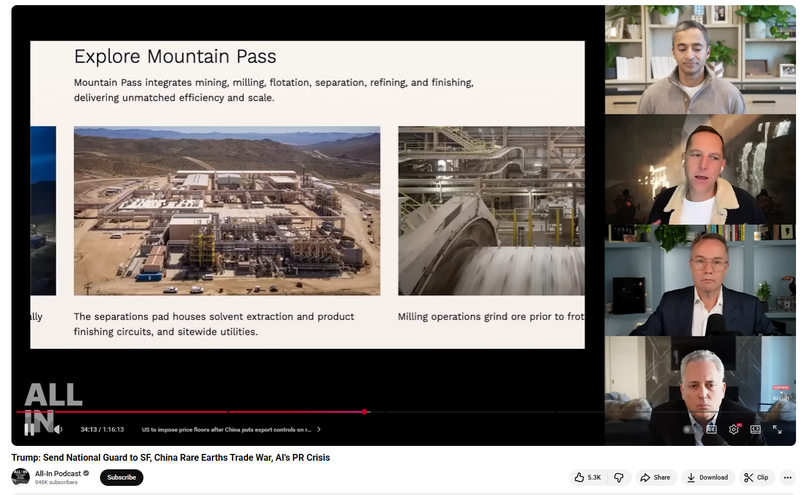
(Listen to that part starting at ~33:16 here)
LKY is trying to solve that environmental problem, especially with respect to antimony...
Here is what LKY is working on at the moment:
What's next for LKY?
🔄 Drilling results from Desert Antimony Mine
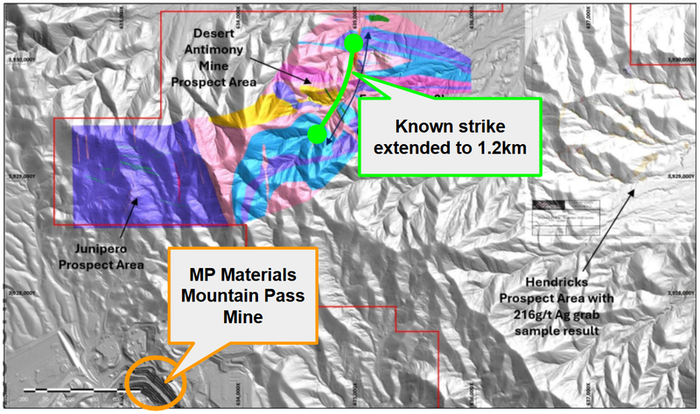
LKY is currently drilling at DAM - targeting extensions to the old workings to the north and south.
We want to see if LKY can prove that the mine extends over the 1.2km of strike mapped earlier in the year. Results should start coming through soon - this is the big one.
(Source)
🔲 Product qualification with defence and industrial partners
LKY has now produced both antimony ingots and 99.5% antimony trioxide from its Mojave Project ore. The next step is getting this product qualified with potential customers - metals traders, defence supply chain participants, and government agencies.
Bench-scale validation of DES processing and economic assessment is the next milestone for the Rice University program.
LKY has signed partnership agreements with Rice University, Columbia University and Hazen Research.
Broadly, we want to see LKY progress the following across the three partnerships:
- Pilot plant design and metallurgical test work (Hazen and Rice)
- Production of representative samples for US industrial and defence qualification (Hazen)
- Commercial analysis and process optimisation (Hazen and Rice)
- Rare earth processing tech development (being done with Columbia University)
🔲 US government funding decisions
LKY has a US$191M LOI from US EXIM and a US$43M DPA Title III application in play. (source)
With the Pentagon actively deploying capital into antimony projects, we think LKY could be in conversation the next time funding goes out.
🔲 Rare earths drilling at El Campo
Following the antimony drilling, LKY will move to its rare earths targets that sit within MP Materials' ground package - testing areas where rock chip sampling returned grades up to ~6.87% TREO.
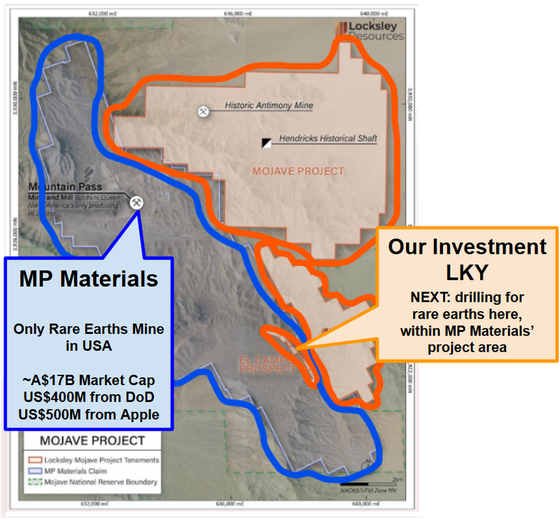
(source)